Averer Web SDK
Overview
The Averer Web SDK is a developer toolkit for integrating privacy-preserving identity, verification, and wallet functionality into your application. It provides drop-in React components and hooks that handle complex zero-knowledge proof interactions and blockchain operations, so you can focus on your product.
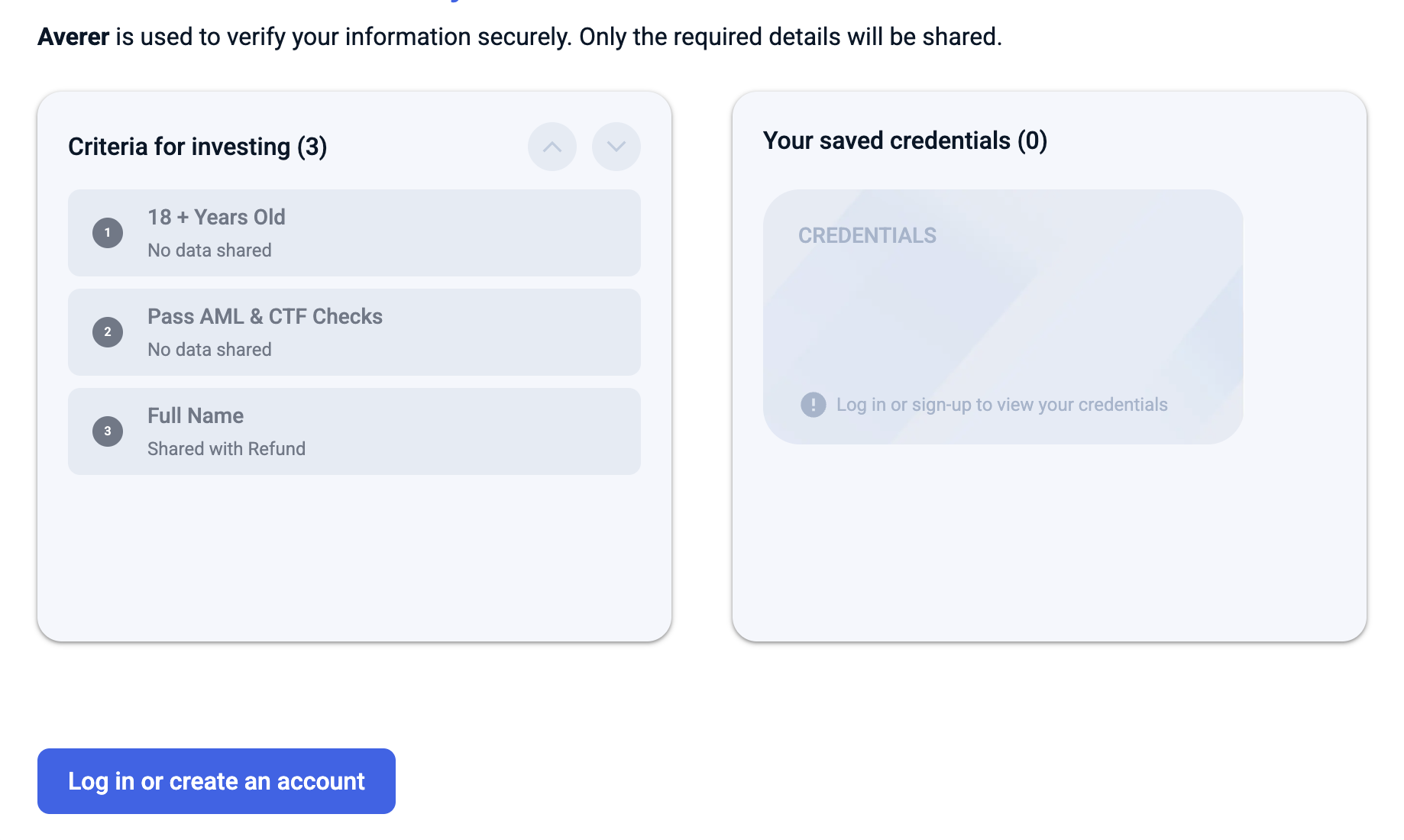
At the core of the SDK is the Averer Wallet, an embedded identity and blockchain wallet that abstracts all web3 primitives away from the user. Every feature in the SDK is built on top of this wallet layer, giving your users a familiar, web2 experience while enabling powerful on-chain capabilities.
What the SDK provides
- Embedded Wallet: a fully integrated blockchain wallet with gas abstraction and account abstraction. Users never need to manage private keys, install browser extensions, or acquire tokens to pay for gas. See the Averer Wallet section.
- Eligibility Verification: privacy-preserving credential verification for both individuals (KYC) and businesses (KYB), using zero-knowledge proofs and selective disclosure. See Verify with Averer.
- React Components and Hooks: a simple component model that fits into existing React, Next.js, or Vite projects.
How it works
The SDK keeps sensitive information inside the user's embedded wallet while providing your application with trustworthy signals about the user's identity and eligibility.
- Wallet creation: when a user authenticates via email or social login (Apple, Twitter/X, Facebook, and more), the SDK creates and manages an embedded blockchain wallet on their behalf.
- Credential issuance: the user completes identity verification, and verifiable credentials are issued to their wallet.
- Proof generation: when your application requests proof of a credential, the wallet generates a cryptographic zero-knowledge proof, demonstrating compliance without exposing the credential itself.
- Verification: the proof is validated either off-chain by a verifier service or on-chain by a smart contract, and the SDK reports the result back to your application.
Because proofs are generated client-side and validated server-side, documents never leave the user's control. This reduces your liability and gives users confidence in the verification flow.
Why choose the Averer Web SDK?
- Privacy maximising: users prove eligibility without uploading documents or sharing sensitive personal information. When limited PII is required, they can disclose only what's necessary, lowering your data retention risk.
- Simple integration: the React component model fits neatly into existing projects, so you can ship complex verification flows in minutes instead of weeks.
- Reduced fraud: zero-knowledge proofs provide cryptographic guarantees that are far harder to forge or tamper with than traditional document checks.
- Full abstraction: gas fees, wallet management, and blockchain interactions are handled entirely by the SDK. Your users never need to understand or interact with web3 primitives.
- Standards-based: built on W3C Verifiable Credentials and Decentralized Identifiers (DIDs), so your product stays compatible with the evolving digital identity ecosystem.
Core concepts
Before diving into the SDK, it helps to understand a few foundational ideas:
- Verifiable Credentials (VCs) are digital equivalents of physical documents (passports, licences, certifications) that are cryptographically signed by a trusted issuer and held in the user's wallet.
- Zero-Knowledge Proofs (ZKPs) are cryptographic proofs that let a user demonstrate a fact (e.g. "I am over 18") without revealing the underlying data (e.g. their date of birth).
- The Embedded Wallet is a blockchain wallet created and managed by the SDK on the user's behalf, secured by their authentication method. No browser extension or seed phrase required.
- Gas Abstraction means the SDK covers blockchain transaction fees so users never need to hold native tokens to interact with on-chain features.
Next steps
- Get started with the quickstart guide
- Learn about the Averer Wallet
- Set up eligibility verification
- Browse the API Reference